Sizing a 200-Person Uniform Rollout: Size Sets, Fitting Sessions and Why S/M/L Fails
There is a moment in almost every uniform rollout where the HR lead sends round a spreadsheet with one column — S, M, L, XL — and asks 200 people to pick one. It feels efficient. It is also the most reliable way to guarantee that a few dozen of those garments will never be worn.
We have been briefing, sampling and shipping uniform programmes since 2003 as a Singapore-based corporate gifting specialist, now serving Malaysia — and sizing is where more orders go wrong than fabric, colour and branding combined. Not through carelessness, but because a letter on a survey form is not a measurement. This article is the method we use instead: what a size set is, how a half-day fitting session runs, how men’s and women’s blocks differ, and the modest-fit questions most size charts never ask but which decide whether half your team is comfortable at work.
What a headcount survey actually gets wrong
A survey asks people to translate their body into a letter. Four things break in that translation, and they break in predictable ways.
- A letter is not a standard. The M your staff are picturing is the M from whichever brand they last bought. Blocks differ between factories, between fabrics and between a fitted and a relaxed cut. Two shirts both labelled L can be several centimetres apart across the chest.
- People answer aspirationally. A meaningful number choose the size they wore last year, or intend to wear. Nobody does this dishonestly. It still produces garments that come back.
- One letter cannot describe two dimensions. A shirt that fits across the shoulders can be wrong at the waist. Office staff sitting all day and warehouse staff reaching overhead need different room in the same nominal size.
- It ignores the people the chart was not drawn for. Anyone needing a longer sleeve, hem or higher neckline has no way to say so in a single-column form, so they pick the nearest wrong answer and stay quiet.
The practical consequence: exchanges. Exchanges on a uniform order are not a swap — the sizes people want are already gone, so an exchange becomes a top-up production run with its own lead time and a real risk that the replacement garments come off a different fabric batch. Sizing errors are the most common route to the reorder problem described in keeping later reorders identical to the first delivery.
The size set: the thing you order before you order
A size set is one physical garment in each size, made in the fabric and to the block you have chosen, sent before bulk production starts. It is not a mockup for checking the logo — that is a separate sample. Its only job is to let real bodies put the real garment on.
Two rules make it worth the week it costs. First, it must be in the production fabric — a cotton-rich poplin and a poly-cotton twill of the same nominal measurements do not sit the same way on a shoulder. Second, it must include both blocks you intend to produce; a men’s-block size set tells you nothing useful about how the women’s-block garment will fit. Against a minimum of from 200 pcs, a size set is a rounding error. Skipping it is the expensive choice, not the thrifty one.
A half-day fitting session, run properly
For a 200-person rollout across one or two sites, a fitting session takes a morning if it is organised and a week if it is not. This is the run sheet we hand to clients.
Fitting-session run sheet
- Book a room with a door and a mirror. Not a glass-walled meeting room. Attendance drops sharply when people have to try clothing in view of the floor, and those who skip it are disproportionately the ones whose sizes are hardest to guess.
- Hang the size set in ascending order, one rail per block. Men’s on one rail, women’s on another, clearly labelled. Mixing them is the fastest way to record the wrong data.
- Slot people in by department, fifteen minutes per group of eight. Departments arrive together, keep each other honest about fit, and go back to work together.
- Record three things per person, not one. Name or staff number, block, size — plus a free-text note. The note field is where “needs longer sleeve”, “prefers one size up” and “maternity” get captured.
- Have one person do all the recording. Self-recorded sheets produce inconsistent size codes, and inconsistent codes cannot be totalled.
- Photograph the tally before anyone leaves the room. Paper tallies go missing between the fitting room and the procurement inbox more often than anyone admits.
- Close the list with a stated deadline. Anyone who has not attended by then is allocated by their line manager, and is told so in advance.
For multi-branch companies the size set travels: one site per day, couriered overnight, tally consolidated centrally. It adds days to the calendar, so it belongs in the plan from the start.
Men’s block, women’s block, and the “unisex” compromise
“Unisex” is a men’s block with the sizes relabelled. That is not a criticism of unisex garments — for a warehouse team or a short-term event crew it is a perfectly sensible, cheaper choice. But it should be a decision, not a default, because the two blocks differ in more places than most briefs assume.
A women’s-block shirt is drafted with a narrower shoulder relative to chest, shaping through the waist, a different armhole, different button spacing to control gaping at the bust, and a different sleeve length progression. It also buttons the other way, which matters more than you would expect the first time a name tag is placed. Front-of-house and corporate teams notice all of this; the shirt either looks tailored or it looks borrowed.
Where budget forces one block, put the women’s block where it is seen — reception, sales, front desk — and use unisex behind the scenes. The comfort trade-off is real either way, and it interacts with fabric: a stiffer, heavier cloth punishes a compromised fit far more than a lighter one does, which is why the block decision should be made alongside how fabric weight behaves in an air-conditioned office rather than after it.
Modest fit is a specification, not a special request
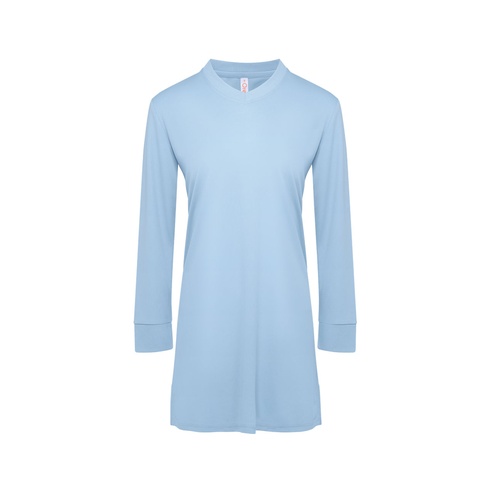
In most Malaysian workplaces a substantial share of the team will want, or be required by role, to wear long sleeves, a higher neckline and a longer hem, and to have the garment work with a tudung. Treating that as a case-by-case exception puts the burden on the individual to raise it, and produces garments that arrive late because they were specified after the main run. It is far simpler to make the modest fit a standard option from the first brief. These are the points we ask about before drafting:
| Specification point | What we need decided | Why it matters on the floor |
|---|---|---|
| Sleeve | Full long sleeve as standard, or long sleeve offered alongside short | Deciding late means two runs on two fabric batches |
| Cuff | Buttoned cuff versus elasticated or adjustable | Kitchen and clinical roles need cuffs that stay put when hands are raised |
| Neckline and collar | Collar height and stand, and how the first button sits | A collar that fights a tudung gets worn open, undoing the uniform look |
| Hem length | Tuck-in length, or a longer untucked hem, or both as options | Untucked wear needs extra body length, or it rides up when seated |
| Body ease | How much room through bust and hip on the women’s block | A looser drape is often requested and cannot be added after cutting |
| Fabric opacity | Whether the chosen cloth needs a heavier weight or a lining at the yoke | Light colours in thin cloth are the most frequent late-stage objection |
| Accessory | Whether a coordinating tudung or scarf is part of the programme | Colour must match the shirt batch, not be approved separately later |
Deciding these at brief stage costs one conversation. Deciding them after the size set has been fitted costs a redraft; after bulk cutting it costs a second order. Our corporate uniform Malaysia range carries dedicated long-sleeve and Muslimah blocks rather than treating them as modifications.
The size grid we build with you
Once the fitting session is done, the tally becomes a size grid — the document that is quoted against, cut against, packed against and, a year later, reordered against. These are the fields it carries and the error each one is there to prevent.
| Field | What it records | The error it prevents |
|---|---|---|
| Garment code | Which style, in which fabric and colourway | Two departments quietly ordering different garments under one name |
| Block | Men’s, women’s or unisex | A tally that totals correctly but cuts wrongly |
| Size code | The exact code from the size set label | “Medium”, “M” and “M (ladies)” being counted as three sizes |
| Sleeve option | Long or short, per person | A second production run for the long-sleeve group |
| Name text | Exactly as it should be embroidered, including diacritics | Spelling corrections discovered at distribution |
| Role or department | The wording and any colour code attached to it | Packing that cannot be split by branch on arrival |
| Site or branch | Where that person’s garments are to be delivered | One central carton that HR has to re-sort by hand |
| Issue count | How many garments each person receives | A total that assumes one each when the roster needs more |
Buffer stock and the new-joiner problem
Every uniform programme has a slow leak: new joiners, replacements for damaged garments, and the handful of people whose size changes. Handled reactively, each becomes a small order with a full lead time attached. Handled at the outset, they are part of the first quantity.
Build the buffer from your own numbers rather than a rule of thumb: take your realistic intake for the next twelve months, weight it towards the middle sizes where most of the headcount sits, and add a small allowance at the extremes so a new joiner is not left waiting. Store it flat in a dry cupboard rather than a humid store room, and log what comes out so the next reorder starts from a real figure. Garments held for a year and issued alongside fresh ones also need the shrinkage allowance after the first wash to be understood before anyone compares them side by side.
What to send us so sizing does not become the bottleneck
- Total headcount by site, and whether every site wears the same garment.
- Men’s and women’s blocks, unisex, or a mix by role.
- Sleeve, hem and neckline decisions, including whether the modest fit is standard or optional.
- Your rollout date — we work the calendar back from it.
- Logo artwork in vector format (AI, EPS or PDF); we can help if the original file has been lost.
- Whether names, roles or department colour coding are part of the programme.
From there: digital mockup in about one business day, size set fitted, grid confirmed, artwork approved, then 21–45 days of production plus roughly 15 days shipping. Express production in 10 working days exists for limited styles and quantities, but it is no substitute for running the fitting session on time.
Frequently asked questions
Do we have to fit all 200 people?
No, but fit everyone customer-facing, everyone who has ever raised a fit issue, and a genuine cross-section of the rest. Existing size records are a legitimate starting point — provided the new block is checked against them with the size set rather than assumed to match.
How long does a size set add to the schedule?
Allow for the sample to be produced and delivered, then a fitting window your sites can realistically meet. It runs in parallel with artwork approval, so it adds far less to the calendar than a post-delivery exchange round does.
Can different departments have different garments in one order?
Yes — several garment codes and colourways can sit inside one programme and count towards the same total. That is usually the better route, because everything is cut and finished in the same production window, which matters for colour agreement across departments.
What is the minimum order for a custom uniform?
From 200 pcs across the programme. Send the garment mix, quantity and size breakdown and we will advise the best options, together with a free digital mockup and a no-obligation quote. Invoicing is SST-compliant and we are set up for ePerolehan buyers.
Can you supply maternity or extended sizes?
Tell us at brief stage and we will include them in the size set, fitted like any other size. Adding them after bulk cutting, once the fabric batch is committed, does not work well.
Send us your headcount and we will size it properly
Tell us how many staff, how many sites and which roles need a modest fit, and we will come back with a garment recommendation, a size-set plan and a rollout calendar — usually within one business day. Start by browsing the custom uniform Malaysia collection, then send the brief.
MOQ from 200 pcs · free digital mockup · nationwide delivery across Kuala Lumpur and the rest of Malaysia · SST invoice · ePerolehan-ready.
WhatsApp +60 10 717 5924
Send your brief
Aquaholic Gifts Malaysia · AS80, Jalan Hang Tuah 4, Taman Salak Selatan, 57100 Kuala Lumpur