Your Office Is Now 24 °C: Choosing Uniform Fabric Weight for the Room It Is Worn In
On 2 April 2026 the Deputy Prime Minister, Datuk Seri Fadillah Yusof, directed that air-conditioning in all government offices be set no lower than 24 °C. Five days later, on 7 April, the Public Service Department issued a dress-code update — batik mandatory on Thursdays and encouraged on every other working day — and said plainly that it was there to keep staff comfortable now that the cooling had been dialled back.
That is the clearest signal in years that the Malaysian office is not the cold room it used to be, and it lands squarely on anyone about to specify a uniform. A shirt drafted for a 21 °C floor and a shirt drafted for a 24 °C floor are not the same garment. We have been specifying corporate wear since 2003 as a Singapore-based corporate gifting specialist, now serving Malaysia, and this is the article we would want a buyer to read before choosing a cloth: what GSM actually tells you, why weave matters more than weight, and how to match a fabric to the room it will be worn in rather than to a brochure adjective.
The number your building is now designed around
MS 1525, the Malaysian Standard covering energy efficiency in non-residential buildings, recommends indoor design conditions of roughly 24–26 °C at 55–65% relative humidity. The April 2026 directive simply pulled government practice into line with the number the standard has carried for years, and a good deal of the private sector has been quietly moving the same way for cost reasons.
Two degrees does not sound like much. In garment terms it is the difference between a cloth whose job is to insulate slightly and one whose job is to move moisture. It also removes the old escape route: for years an over-heavy uniform was survivable indoors because the air-conditioning did the work. At 24 °C, with humidity in the range MS 1525 anticipates, the cloth has to do more of it. METMalaysia is blunt about the outdoor half — sitting on the equator, the country’s annual temperature variation is under 2 °C, so there is no winter specification to hide behind.
GSM is a weight, not a quality rating
GSM — grams per square metre — is the spec most buyers ask for and the one most often misread. It tells you how much material there is per unit area. It does not tell you how strong the cloth is, how well it breathes, how opaque it is, or how it feels at the end of a shift.
Three shirtings at the same GSM can behave completely differently depending on yarn count, how tightly they are woven and the fibre blend. A finer, tightly woven cotton can weigh the same as a coarser, looser one and feel crisper, cooler and considerably more expensive-looking. A light polyester can weigh less than a light cotton and still feel warmer, because it moves moisture to the surface rather than absorbing it — which works beautifully in a ventilated environment and much less well in a still office.
Ask for four numbers, not one. When you request a fabric spec, ask for fibre composition, GSM, weave type and yarn count together. Any one of them alone is close to meaningless. All four together let you compare two suppliers’ cloths honestly — and they give you something to check the delivered goods against later.
Weave: the spec that decides how a uniform reads
Poplin
A plain weave with a fine, smooth, flat surface. It is the lightest and coolest of the standard corporate shirtings and takes a crisp press well, which is why it dominates front-desk and executive wear. The trade-offs: it shows creases readily, and in pale colours at low weight it can be less opaque than people expect. Poplin rewards a slightly higher weight in white and light blue.
Oxford
A basketweave with a visible texture and more body. It hides creases far better than poplin, which matters enormously for staff who sit in a car between branch visits, and its texture disguises minor colour drift between batches. It is warmer, though, and a heavy oxford in a 24 °C office is a common comfort complaint. Oxford is also the easiest weave to embroider cleanly — the texture supports the stitch.
Twill
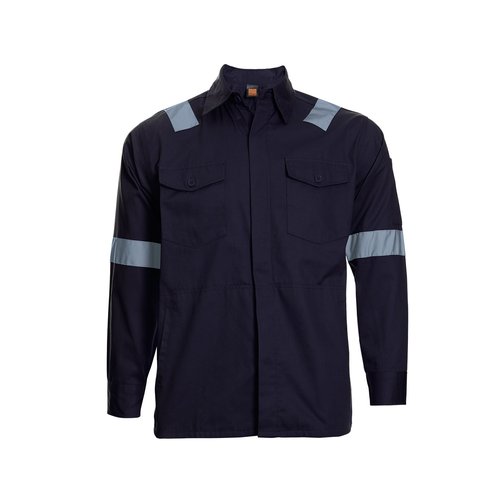
Recognisable by its diagonal ribbing. Twill drapes softly, resists creasing well, hides light soiling and is markedly more abrasion-resistant than a plain weave at the same weight — which is why it is the default for workshop, technical and field roles. The diagonal structure also means it needs to be cut consistently in one direction, so it is not the cloth for a supplier who is casual about lay planning.
Performance knits
Moisture-wicking knitted fabrics move perspiration to the outer surface where it can evaporate. They are the right answer for roles that are physically active, outdoors, or in a hot kitchen — and the wrong answer for a still, cool office, where there is little air movement to complete the evaporation and the fabric can simply feel damp. They also take embroidery differently from a woven cloth and need a backing to stop the stitch distorting.
The four rooms a Malaysian uniform has to work in
Most companies specify one uniform for everybody and then wonder why two departments complain. It is more useful to think in rooms than in job titles. This is the frame we use when a brief covers a mixed workforce.
| The room | What the body is doing | Fabric direction | The failure to design out |
|---|---|---|---|
| Conditioned office at 24–26 °C | Seated, little air movement, long hours | Lighter woven shirting, cotton-rich or a balanced blend; smooth weave | A heavy cloth chosen for “smartness”, now too warm for the setpoint |
| Front of house and retail floor | Standing, moving, doors opening to outside air | Textured weave that hides creasing; blend with good recovery | A garment that looks pressed at 9am and rumpled by 11am |
| Kitchen, back of house, service | Hot, humid, frequent washing, staining | Durable blend or performance knit; mid-tone colour; wash-robust construction | White or very pale cloth that is unrecoverable after a month |
| Outdoors, site, field visits | Sun, rain, movement, abrasion | Twill or hard-wearing blend; long sleeve for sun; deeper shades | A light office shirting sent outdoors and worn through at the shoulder |
You do not need four different uniforms. You need one design language — same colour, same logo treatment, same collar shape — expressed in two or three cloths. That keeps the brand consistent while letting each team wear something appropriate, and it is exactly the structure the garments in our corporate uniform KL fabric options are built around, from lighter corporate shirting through to workshop-grade cloth.
Blends, and what each one is really buying you
Fibre content is a set of trade-offs, not a ladder from worse to better.
- Cotton-rich. Best next-to-skin comfort and absorbency, best breathability in a still room, and the most natural hand. It creases more, it takes longer to dry in humid air, and it is the most likely to shrink on the first wash. Excellent for corporate and front-desk wear where garments get pressed.
- Poly-cotton and CVC. The workhorse. Polyester adds crease recovery, dimensional stability and colour retention; the cotton portion keeps it comfortable. A cotton-dominant CVC leans towards comfort, a polyester-dominant blend leans towards easy care and shape retention. This is where most multi-department programmes land.
- Tetron-rayon. A polyester–viscose type of blend with a softer, more fluid drape and a slight sheen. It reads more formal than poly-cotton and is a long-standing choice for corporate and institutional uniforms across the region. It is comfortable in a conditioned office and less suited to heavy physical work.
- High-polyester performance. Fastest drying, most colour-stable, best for active and outdoor roles. It needs air movement to feel good, so it belongs outside the still office rather than inside it.
The construction details that beat the cloth
Once the fabric is chosen, comfort is decided by a handful of construction decisions that rarely appear on a quotation but always appear in the complaints.
- Collar interlining. A stiff fused interlining looks sharp on day one and is the first thing people loosen at 24 °C. A softer construction is more comfortable and ages better; a very stiff one can also bubble after repeated washing.
- Yoke lining. A lined yoke adds opacity across the shoulders — the single most effective fix for a pale shirting that is otherwise perfect — but it also adds warmth. Specify it deliberately.
- Armhole and sleeve head. A slightly higher armhole gives more arm movement without pulling the whole garment, which matters for anyone reaching, serving or driving.
- Back detail. A box pleat or side pleats add movement room; a plain back looks cleaner. This is a fit-versus-look call and should be made at the same time as the fit is checked in the size-set fitting session, not afterwards.
- Seam finish. A properly finished side seam survives frequent laundering; an unfinished one frays first at the underarm, which is also where perspiration does its work.
Colour, sweat and the shirt nobody wants to wear
In a warm, humid climate, colour is a comfort decision as much as a brand one. Mid-tone solids in the middle of the value range are the most forgiving: pale blue, grey and stone show perspiration far less than a saturated mid-blue or a deep, warm colour, and far less than white does once a garment has been worn for a while. Very dark shades hide moisture well but absorb heat outdoors and show lint and dust indoors.
Texture helps too. A weave with some surface interest breaks up the appearance of a damp patch in a way that a flat, smooth cloth does not. If your brand colour is unavoidably a high-contrast shade, consider carrying it in the collar, placket or trim rather than across the whole body — and check how it will hold, because saturated shades are also the ones most exposed to colourfastness and fading over a year of laundering.
Write the fabric spec so it can be checked on arrival
A fabric described as “premium breathable cotton blend” cannot be verified against anything. A spec that reads “65/35 poly-cotton, plain weave, stated GSM, stated yarn count, colour approved against signed lab dip” can be checked at delivery and quoted again identically next year. Put the agreed spec on the purchase order, keep the approved swatch, and record it alongside the artwork.
That written spec is also what makes a multi-cloth programme manageable. When corporate wear, service wear and field wear all sit on one document, adding a new site or a new team is a matter of quoting an existing line rather than starting again — and it makes department colour-coding across a fleet something you can plan rather than improvise.
Frequently asked questions
What is the best uniform fabric for a Malaysian office?
For a conditioned office now running at 24–26 °C, a lighter woven shirting in a cotton-rich or balanced poly-cotton blend, in a smooth weave, is the safest starting point. Reserve heavier oxford and twill for roles that move, and performance knits for roles that are outdoors or in the heat.
Is a higher GSM always better quality?
No. Higher GSM means more material, which usually means more durability and more opacity — and more warmth. In a tropical climate, weight above what the role needs is a comfort cost, not a quality gain. Judge the cloth on composition, weave and yarn count together with GSM.
Can we mix fabrics across departments and still look like one company?
Yes, and it is usually the better answer. Hold the colour, logo placement and collar style constant and let the cloth vary by role. Approve the colour across all the cloths in the same round, because different fabrics take dye differently and need to be judged side by side.
Does batik on Thursdays change what we should order?
The April 2026 circular applies to the public service, and it left uniform requirements for designated officers unchanged. But it is a useful planning signal: if part of the week is batik, the number of corporate shirts each person actually needs may be lower than a straight one-per-working-day calculation suggests. Work that out before you fix the quantity.
How many fabrics can one order cover?
Several. The minimum for a uniform programme is from 200 pcs in total, and that total can be spread across garment types, cloths and colourways within the same production window — which is the best way to keep the colours agreeing across departments.
Tell us the room, and we will recommend the cloth
Send us your departments, what each team actually does all day and your brand colours, and we will come back with a fabric recommendation, a free digital mockup and a quote — usually within one business day. You can browse our corporate uniform collection first to see the garment and fabric options side by side.
MOQ from 200 pcs · production 21–45 days after artwork approval plus about 15 days shipping · express 10 working days on limited styles and quantities · nationwide delivery · SST invoice · ePerolehan-ready.
WhatsApp +60 10 717 5924
Send your brief
Aquaholic Gifts Malaysia · AS80, Jalan Hang Tuah 4, Taman Salak Selatan, 57100 Kuala Lumpur