Your Logo Crosses a Seam: Artwork on a 32-Panel Football, and the Case for the Mini
Artwork on a curved surface · Malaysia
Your designer works on a flat rectangle. A football has no flat surface anywhere on it, thirty-two panels, ninety seam edges, and a viewer who can only ever see half of it at once. The gap between those two facts is where corporate football artwork goes wrong — not in the colours, not in the resolution, but in the decision about how the design meets a seam and which panels a camera will actually record. Here is how we lay artwork onto a sphere, and why the mini ball is the format most corporate footballs should have been in the first place.
This is not an article about which printing process to pick. It is about geometry: what the panel grid allows, what the seam takes away, and how to size a mark so it survives both. Everything below applies whether the ball in front of you is stitched or bonded, although the join changes how harsh the seam break looks — that difference is set out where thermal-bonded and stitched seams compared is the whole subject.
The panel grid is your canvas, whether you like it or not
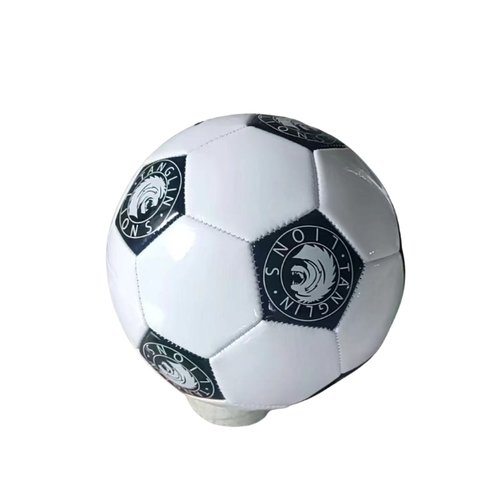
A classic football is twenty hexagons and twelve pentagons. Work backwards from a size 5 ball — 68 to 70 cm around, so roughly 22 cm across — and each panel edge comes out at about 4 to 4.5 cm. That gives you a hexagon roughly 7 to 8 cm from one flat side to the other, and a pentagon a little smaller. Those are the real dimensions of your branding surface, and they are considerably smaller than most people picture when they imagine “printing on a football”.
Panels are also not flat. An inflated ball pushes each panel into a shallow dome, so a mark placed near a panel edge is being applied to a surface that is falling away from the viewer. A logo centred in a hexagon reads cleanly. The same logo pushed to fill the hexagon edge to edge distorts at its outer thirds and disappears entirely at the seam.
Three ways to lay a design onto the grid
One: inside a single panel
The logo is sized to sit comfortably within one hexagon or pentagon with clear margin on every side, and repeated on several panels around the ball. Nothing crosses a seam, so nothing breaks. This is the most reliable approach and the one we recommend for any logo with fine detail, thin strokes or small type.
Two: the panel set
The design treats a cluster — typically a pentagon and the five hexagons around it — as a single unit. Colour blocks and shapes are assigned to whole panels, so seams fall between elements rather than through them. Visually this is the strongest option on a football, because it uses the grid rather than fighting it, and it is how most striking football graphics are actually built.
Three: the full wrap
A continuous image runs across the whole ball, seams included. It photographs superbly when it works. It requires artwork built against the specific panel template for that ball, tolerance for a visible interruption at every crossing, and a design that is forgiving of it — gradients, textures and large shapes survive; a wordmark running across three panels does not.
| Approach | Crosses a seam? | Best for | Main risk |
|---|---|---|---|
| Single panel | No | Detailed logos, wordmarks, small type | Reads small; needs repeating to be seen |
| Panel set | Only between elements | Club and sponsor designs, bold brand colours | Needs the correct panel template up front |
| Full wrap | Everywhere | Campaign graphics, photographic themes, display balls | Visible break at each crossing; type must not span seams |
What a seam actually does to a line that crosses it
Three separate things happen at a seam, and only the first is obvious.
The seam is a physical trough. Ink laid across it either misses the bottom of the valley or sits in it unevenly, so a straight line entering the seam does not emerge in a straight line on the other side. On a stitched ball the trough is deeper and the break is more pronounced; on a bonded ball it is shallower but still present.
The two panels also do not sit at the same angle. They meet at a fold, so a shape crossing from one to the other changes plane mid-stroke. A circle spanning two panels reads as a slightly kinked oval from every angle except one. And on a stitched ball, panel positions vary by a millimetre or two from unit to unit, which means artwork registered perfectly on the first ball is registered slightly differently on the two-hundredth. Design that assumes millimetre alignment across a seam will produce a batch that looks inconsistent, and the inconsistency will not be a fault anyone can be asked to fix.
The rule our artwork team applies: never let type cross a seam. Shapes and colour fields can cross one; letters cannot. If a wordmark will not fit inside a single panel at a readable size, the wordmark belongs on the packaging or on a bundled item, not on the ball.
Which panels a camera actually sees
This is the calculation almost nobody makes, and it changes the brief. From any single viewpoint you see one hemisphere — about half the thirty-two panels. But panels near the silhouette edge are so steeply angled that anything printed on them is compressed into a sliver. In practice only six to eight panels face the viewer squarely enough for a logo on them to be legible in a photograph.
Which six to eight is entirely random. Nobody places a football deliberately. It lands where it lands on the handover table, in the group photo, on the shelf behind someone in a video call. So the branding question is not “where do we put the logo” but “how many times do we repeat it so that at least one instance faces the camera from any orientation”.
The repeat rule we brief designers with
- One instance: a display ball in a case, in a fixed and chosen orientation. Nothing else.
- Two or three instances, spread apart: the honest minimum for a ball that will be photographed once, on a table.
- Five to six instances, distributed around the sphere: the setting we default to for gifting. One always faces the camera, and the ball never looks blank from any side.
- Every second panel: for roadshow and activation balls that will be handled, thrown and filmed continuously. It reads as a pattern rather than a logo, which is exactly the intention.
Repeating a mark also removes the argument about which panel is the “front”. There is no front on a sphere — there is only the panel that happens to be pointing at someone.
The case for the mini ball
Most corporate footballs are ordered at size 5 because that is what a football is. Then they are handed to people in office clothes at an event with no pitch, carried home on the LRT, and put in a cupboard. Meanwhile the mini ball — size 1, and to a lesser extent size 2 — does the job the gift was actually bought for.
A mini sits on a desk. It sits on a shelf behind someone on a video call. It travels in a bag without a thought, it fits far more units into the same carton, and it survives being handed to someone at a booth who then has to carry it around for three hours. Its branding logic is different too: the panels are smaller, so a single-panel logo has to be simpler, but the whole ball is taken in at once by the eye instead of one hemisphere at a time.
| Size | Approx. circumference | What a single panel gives you | Where it belongs |
|---|---|---|---|
| 1 (mini) | 46–51 cm | Small panel — symbol or short wordmark only | Desk gifts, booths, delegate packs, shelf display |
| 2 | Around 54–56 cm | Enough for a compact lock-up | Children’s activities, novelty gifting |
| 3 | 58–61 cm | Comfortable for most logos | Junior academy play |
| 4 | 63.5–66 cm | Full logo plus a tagline | Youth play, futsal-adjacent use |
| 5 | 68–70 cm | Hexagon roughly 7–8 cm across | Adult play, clubs, sponsorship gifting |
The split we most often end up recommending is a small number of size 5 balls for the people who will genuinely play with them, and minis for everyone else. It puts more logos in more offices for the same outlay, and it removes the pump problem entirely for the majority of recipients — a subject worth reading properly, because valves, pumps and pressure loss account for most of the disappointment a football gift ever causes.
The artwork brief that saves a revision round
- Vector artwork, with all type converted to outlines. On a curved surface any font substitution shows immediately.
- Brand colours given as a colour reference number, not as an on-screen value. Panel material takes ink differently from paper.
- A stated minimum size for your mark, so nobody scales it below legibility to make it fit a panel.
- A one-colour version supplied alongside the full-colour one. It is often the version that survives best on a coloured panel.
- The panel template for the specific ball, requested before the designer starts rather than after the first mockup.
- A decision, in writing, on how many panels carry the mark — using the repeat rule above.
Send those six things together and the first mockup is usually close to final. Send a logo alone and you will spend a revision round discovering the panel dimensions the hard way. Our range of printed footballs with your logo covers the sizes above, and the mockup shows your artwork on the actual panel grid rather than on a flat rectangle.
Order basics
Minimum order is 200 pcs. Production takes 21–45 days after artwork approval depending on quantity and specification, plus roughly 15 days shipping, with an express route of 10 working days for limited styles and quantities. Artwork approval is the clock start, so the six points above are worth settling early — a week lost arguing about a wordmark on a seam is a week off your buffer before Merdeka, a sports day or a tournament that cannot move. Quote-only, invoiced with SST, ePerolehan-ready for government buyers.
Football artwork questions we get asked
Can my logo run across more than one panel?
Shapes and colour fields can. Type should not — letters crossing a seam distort at the fold and read badly from every angle. If the wordmark is essential at size, put it on the packaging instead.
How many panels should carry the logo?
Five or six spread around the ball is our default for gifting, because a ball lands in a random orientation and you want a mark facing the camera whichever way it settles.
Is a mini ball taken seriously as a corporate gift?
It is taken more seriously than a size 5 ball nobody has room for. A mini is a desk object with your logo on it. Boxed properly, it presents at least as well and is far easier for a recipient to take home.
Will the design look identical on every ball?
Panel positions vary very slightly between units, so artwork that relies on exact alignment across seams will show small differences across a batch. Artwork kept inside panels is consistent unit to unit.
What should I send with the brief?
Vector artwork with outlined type, a colour reference number, a one-colour version, your chosen size, and how many panels should carry the mark. We supply the panel template.
Send the logo and we will show you the panel grid
Aquaholic Gifts is a Singapore-based corporate gifting specialist established in 2003, now serving Malaysia from AS80, Jalan Hang Tuah 4, Taman Salak Selatan, 57100 Kuala Lumpur. Ask about custom football printing for KL events and you will get a free digital mockup, usually within one business day.