Thirty-Two Panels, Ninety Seams: Hand-Stitched, Machine-Stitched or Thermal-Bonded
Football construction · Malaysia
A football is not one object. It is thirty-two pieces of coated fabric, ninety seam edges and sixty corners where three panels meet. How those ninety edges are joined — by hand, by machine, or by heat and adhesive with no thread at all — decides whether the ball still looks round in November, how much rain it drinks on a wet pitch in Shah Alam, and what “promotional grade” on a quotation actually means. It is the part of the specification almost nobody asks about.
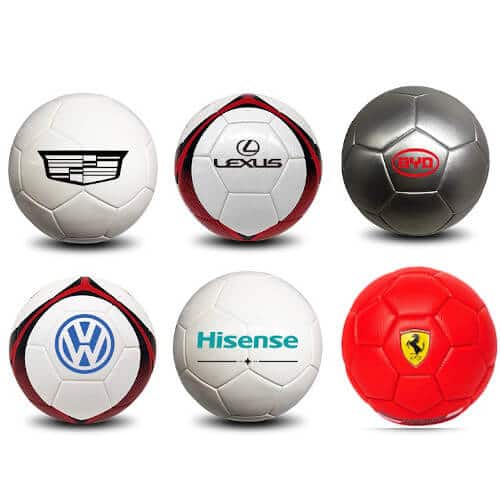
Most football briefs we receive specify a size, a colour and a logo. Almost none specify a join. That is understandable — the join is invisible in a product photo. But it is the single largest difference between two balls that look identical in a catalogue and cost very different amounts to make. This article is about what happens where two panels meet; our custom footballs in Malaysia page sets out the styles and branding options, so come back here when you are ready to interrogate a sample.
The shape you are actually buying
The classic football is a truncated icosahedron: twenty hexagons and twelve pentagons, thirty-two panels in total. Geometry gives that solid exactly ninety edges and sixty vertices. Every one of those ninety edges has to be closed, and every one of those sixty vertices is a point where three seams converge — the hardest place on the ball to keep flat, and the first place a poorly made ball starts to bulge.
Under the Laws of the Game, a size 5 ball measures 68–70 cm around, weighs 410–450 g at kick-off and is inflated to 0.6–1.1 atmospheres, roughly 8.5 to 15.6 psi at sea level. Those numbers describe the finished object and say nothing about how it was assembled — which is why two balls can both meet them and behave nothing alike after a season.
Panel count varies. Modern match balls have moved towards fewer, larger, moulded shapes, and the cheapest promotional balls sometimes print a pattern that only imitates panels. But the thirty-two-panel ball remains the format most corporate footballs are built on.
Join one: hand-stitched
In a hand-stitched ball, each panel is pre-punched with a line of holes near its edge. A stitcher works with the panels inside out, pulling waxed polyester thread through opposing holes and locking each stitch by hand until one seam remains open. The bladder goes in through that gap, the ball is turned right side out, and the last seam is closed from the outside.
Because the stitcher can pull each stitch to the tension the seam needs, the seams sit deep and even. That is what gives a hand-stitched ball its shape retention: the panels are pulled snugly against the internal lining, so the ball has less freedom to distort into an egg after a few hundred hard contacts with a concrete wall.
The trade-off is time. Ninety edges stitched by hand is several hundred stitches per ball and a substantial slice of a working day per stitcher, which is why hand-stitched construction sits at the top of the promotional range and should never be compared like-for-like against a machine-stitched line.
Join two: machine-stitched
A machine-stitched ball is closed on an industrial sewing machine, panels fed through in sequence and the seam laid down at speed. Output per shift is many times higher, which is why this is the default for training balls and most promotional footballs.
What you lose is seam depth and, in cheaper lines, consistency. A machine seam sits shallower, so more thread sits proud of the panel surface where boots, tarmac and school-field gravel abrade it. That is where these balls fail first: not the panel, not the bladder, but a thread sanded through on one edge, after which the panels separate at the weakest vertex.
This is not a reason to avoid machine stitching. For a ball kicked around a car park at a family day and then kept in a cupboard, it is entirely honest. It is only a problem when a machine-stitched ball is sold into a use case that needed a hand-stitched one — an academy handing balls to children who will use them weekly, for instance.
Join three: thermal-bonded
Thermal bonding removes thread entirely. Panel edges are joined with adhesive and heat under pressure in a mould, so the finished surface has no needle holes and only a shallow groove where a seam would be, with more uniform mass distribution.
Two things follow. First, water: with no stitch holes there is no capillary path into the ball through the seam, which is why top-flight match balls moved to bonded construction. Second, an unbroken surface is friendlier to artwork that runs across a join, which matters when you are laying a logo across curved panels rather than dropping a mark inside one hexagon.
The honest caveat is that “thermal-bonded” describes a process, not a quality level. Made with good adhesive and correct dwell time and pressure, a bonded ball is superb. Made cheaply, it delaminates — the panel lifts at a corner, and unlike a burst stitch that cannot be repaired. When a bonded ball is quoted at a giveaway price point, that is the risk you are pricing in, so flex a sample hard at a vertex before you commit.
Production-floor note: the fastest way to tell the three apart without a spec sheet is to run a thumbnail along a seam. Hand-stitched gives a deep valley with evenly spaced thread. Machine-stitched gives a shallower valley with a tighter, mechanical stitch pitch. Thermal-bonded gives a smooth groove and no thread at all.
The three joins, compared honestly
| Attribute | Hand-stitched | Machine-stitched | Thermal-bonded |
|---|---|---|---|
| Seam depth | Deep, even | Shallow, thread proud of surface | Moulded groove, no thread |
| Shape retention over a season | Strongest of the three | Good if lining is right; varies by line | Very good when bonded properly |
| Water pickup in rain | Moderate; depends on thread and lining | Highest — more exposed holes and thread | Lowest — no needle holes |
| Typical failure mode | Single burst stitch, repairable | Thread abraded, panels separate | Delamination at a corner, not repairable |
| Artwork across a seam | Visible break at every crossing | Visible break at every crossing | Shallowest break; kindest to full-wrap designs |
| Where it belongs in a corporate order | Club and academy gifting, balls that get used | Family days, roadshows, volume giveaways | Premium sponsor gifts and full-wrap artwork |
What the monsoon does to a seam
Malaysia gives a football a harder time than the specification sheet imagines. An afternoon thunderstorm in the Klang Valley leaves standing water for the rest of the session, and a north-east monsoon weekend on the east coast can mean a ball is never really dry from Friday to Sunday.
Water gets in through two routes: the stitch holes, and the panel surface itself if the coating is thin or already scuffed. The immediate effect is weight — a soaked ball is heavier and flies differently, which is why FIFA’s test programme for footballs includes water absorption alongside circumference, weight, sphericity, rebound, loss of pressure and shape retention after repeated impacts. Promotional footballs are not submitted to that programme and nobody should imply otherwise, but the list is still the most useful checklist a buyer can borrow, because it names the six things that actually go wrong.
The slower effect of water is on the lining adhesive. Repeated soak-and-dry cycles in tropical heat are exactly the conditions under which laminated layers start to let go, and a ball whose lining has debonded will never hold a true sphere again no matter how carefully it is inflated.
The layers you cannot see
Between the outer panel and the bladder sit laminated lining layers, usually polyester or a polyester-cotton blend. Their job is to stop the panel stretching. More, better-bonded layers hold a rounder shape under pressure and resist the slow ovalling that makes an old ball wobble in flight.
When two quotations for the same panel count and the same join come back noticeably apart, the lining stack is often where the difference lives. The outer material matters too: coated polyvinyl chloride is the value option and feels stiffer in cool morning air, while polyurethane is softer, takes a scuff better and photographs better under event lighting.
Our seam inspection: eight things to do to the sample
Before we approve a football line, the sample goes through the same routine. It takes ten minutes and needs nothing beyond a pump, a tape measure and a sink. Run it on any sample you are sent.
- Find the vertices. Locate three or four points where three panels meet and look straight down at them. They should be flat. A vertex that already domes on a brand-new ball will be worse after use.
- Flex a corner hard. Push a vertex inwards with your thumb and hold. On a bonded ball, watch for any panel edge lifting. On a stitched ball, watch for stitches spreading and lining showing through.
- Run a nail along four seams. Note the depth and whether the thread sits below or above the panel surface. Compare seams on opposite sides of the ball — they should feel identical.
- Measure the circumference twice, at ninety degrees. A sphere gives the same figure in both directions. A ball that is already 2 cm out of round at the sample stage will not improve.
- Bounce it ten times from shoulder height onto hard floor and watch the return path. A ball that drifts the same direction every time has a heavy side.
- Wet one hemisphere under a tap for thirty seconds, wait five minutes, then press the seams hard with a dry tissue. Water coming back out means the seam is drinking.
- Check the print at the seam crossings rather than in the middle of a panel. That is where registration errors show.
- Leave it inflated and come back in a week before signing anything — which brings you to the part of the ball nobody inspects at all.
That last step is the one buyers skip, and it is the one that predicts the complaint you will receive in week three. It depends entirely on how a football bladder holds its air, which is a separate decision from the join and is quoted separately too.
What you are buying at a giveaway price point
Here is the part suppliers rarely say plainly. At the lowest end you are buying a machine-stitched or lightly bonded ball with a thin lining stack and a coated polyvinyl chloride outer. It will photograph excellently on the day and it will still be recognisably round months later if it lives indoors. It is not a training ball and should not be described as one to the recipient.
The mistake we see is not buying at the low end — it is buying at the low end and briefing at the high end. If your internal communications say “match ball” and the recipient is a club, the ball will be judged against a club ball and lose. Match the construction to the promise, and the same ball becomes a good gift.
Timeline and order basics
Our minimum order for custom footballs is 200 pcs. Production runs 21–45 days after artwork approval depending on quantity and construction, plus around 15 days for shipping. An express route of 10 working days exists for limited styles and quantities — useful when a tournament date moves, but it narrows your construction choices, so it is worth confirming early rather than assuming. Quotations are issued on request and invoiced with SST; government and statutory buyers are served through ePerolehan.
Football construction questions we get asked
Is hand-stitched always better than machine-stitched?
Better built, yes — deeper seams, even tension, better shape retention. Better for your order, not necessarily. A giveaway ball kicked a handful of times does not need it, and the money is usually better spent on the lining stack or the packaging.
Does a thermal-bonded ball really not take on water?
It takes on far less, because there are no needle holes for water to travel through. Water can still enter through a scuffed or split outer panel, so bonded construction reduces the problem rather than eliminating it.
How many panels should a corporate football have?
Thirty-two is the format most people recognise and the one most promotional lines are built on. Lower panel counts can look striking but change the artwork layout completely, so decide panel count before the designer starts.
Can I mix constructions in one order?
Often yes — better-built balls for presentation and the rest for general distribution is a sensible split. Tell us at briefing stage so the artwork is prepared once for both constructions.
Send us the brief, and we will tell you which join fits it
Aquaholic Gifts has been a Singapore-based corporate gifting specialist since 2003 and now serves Malaysia from AS80, Jalan Hang Tuah 4, Taman Salak Selatan, 57100 Kuala Lumpur. Tell us the audience, the occasion and the date, and you will get a free digital mockup, usually within one business day. Start by looking through our custom football range.