Tipping Is Knitted, Not Printed: The Cheapest Upgrade on a Corporate Polo, and Its Catch
A client once asked whether we could “just print a thin white line along the edge of the collar”. It is a completely reasonable question and the answer is no — and the reason why is the most useful thing anyone can understand about polo trim.
A tipped collar is not decorated. It is knitted. The white line at the edge is a second yarn fed into the flat-bed machine as the collar is being made, row by row, so the stripe is part of the structure rather than something sitting on top of it. That is why tipping never cracks, never peels and never fades differently from the rest of the collar. It is also why brand-colour matching on a tipped polo is a completely different conversation from brand-colour matching on a print.
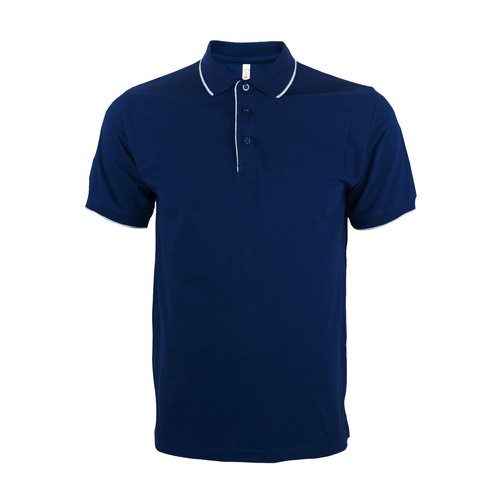
Tipping is the cheapest visual upgrade available on a corporate polo — it changes nothing about fabric, fit or decoration and yet it is the single thing most likely to make people say the shirt looks expensive. It also has one catch that catches almost every first-time buyer. Both are below. Our tipped collar polo corporate styles show the effect on a honeycomb CVC collar if you want a reference while you read.
What tipping actually is
Tipping is a contrast stripe knitted into the outer edge of a collar, and usually the cuff to match. It comes in a small number of standard forms.
| Form | What it looks like | Effect |
|---|---|---|
| Single tip | One narrow contrast line along the collar edge | The quiet, corporate default |
| Double tip | Two lines with a gap of body colour between | More sporting, reads as club or team |
| Wide band tip | A broad contrast band at the edge | Bold; best on dark bodies with a single accent |
| Tip plus contrast under-collar | Stripe outside, contrast colour underneath | Shows only when the collar is worn up or open |
| Cuff tip only | Sleeve edges tipped, collar plain | Subtle; works when a logo already sits on the sleeve |
On a knitted rib collar the stripe is crisp and slightly textured. On a honeycomb or interlock collar it is crisper still, because the denser surface gives the contrast yarn a stable base to sit on — which is why our honeycomb CVC style is the one we recommend when a client wants a fine, sharp tip rather than a soft one.
What tipping cannot do is appear on a self-fabric collar cut from body pique. There is no knitting operation to feed a second yarn into. If your design has a tipped collar, you have already chosen a knitted component collar, which has consequences for how it behaves — and why a knitted collar loses its roll is worth reading alongside this.
The catch: you are choosing a yarn, not a colour
This is the part that surprises people. A printed logo can be matched to a brand colour with reasonable precision because ink is mixed to order. A tipping stripe cannot, because it is made of dyed yarn — and yarn is dyed in production runs, held as stock in a standard colour card, and fed into a machine.
So there are two routes, and they behave completely differently.
Route one: stock tipping colours
The mill holds a card of tipping yarns — white, black, navy, red, grey, and a handful of others. Choose from the card and there is no additional lead time and no additional minimum. The stripe will be a close relative of your brand colour rather than an exact match, and on a two-millimetre line at conversational distance, close is usually indistinguishable.
Route two: a yarn dyed for your order
If the brand colour genuinely has to be exact — a bank, a franchise with a strict identity manual, a livery colour — the yarn is dyed to your reference before the collar can be knitted. This is a real production step of its own, it carries its own minimum quantity separate from the garment order, and it adds time at the front of the schedule rather than the back.
The question to ask at quotation stage
“Is this tipping colour on your standard card, or does it need to be dyed for us?”
The answer changes your timeline and your minimums, and it is the single most common reason a polo project slips. Ask it while you are still choosing colours, not after artwork approval — by then the schedule has already started.
There is a middle path worth knowing about. Because the eye reads a thin stripe by contrast rather than by hue, a stock colour in the right tonal family often looks more “on brand” than an exact match would. A navy body with a white single tip reads as corporate regardless of which navy it is. Save the dyed-to-order route for the cases where an identity manual genuinely demands it.
Where trim lives besides the collar
Four other places, in rough order of how often they are used.
The cuff. Almost always matched to the collar, because a tipped collar over a plain cuff looks unfinished. It is the same knitted component logic, produced at the same time.
The placket tape. A contrast strip behind or alongside the button placket, visible as a thin line when the shirt is worn open. This one interacts with button choice, so read it with button colour, buttonholes and the finishing at the placket before deciding.
The side slit and hem tape. A short contrast binding at the split where the hem panels separate. Invisible when the shirt is tucked in, and one of the nicest details on a polo worn out.
Side panels and shoulder blocks. Whole panels of contrast fabric cut into the body. This is where a polo stops being a corporate garment and starts being a sports garment, and it is a threshold worth crossing deliberately.
The trim ladder: sharp at the top, sporty at the bottom
We use this internally when a client says “we want something a bit different, but still smart”. Each rung adds visual energy. The line most corporate programmes should not cross sits between rungs four and five.
| Rung | What it is | Reads as | Typical fit |
|---|---|---|---|
| 1 | Plain collar, plain cuff | Neutral, unbranded | Government departments, formal service roles |
| 2 | Tone-on-tone tip (same colour family) | Considered, quiet | Banks, professional services |
| 3 | Single contrast tip on collar and cuff | Smart, deliberate | Front-of-house, dealerships, retail |
| 4 | Tip plus contrast placket or under-collar | Designed, still corporate | Hospitality, premium retail, brand teams |
| 5 | Double tip and contrast side slit | Club, sporting | Golf days, association polos, events |
| 6 | Contrast side panels or shoulder blocks | Team kit | Sports teams, activation crews, tournaments |
The useful thing about the ladder is that it separates two arguments that usually get tangled: how much brand colour appears on the shirt, and how sporty the shirt looks. You can put a great deal of brand colour on a rung-three polo and almost none on a rung-six one. Decide which axis the discussion is really about.
How tipping ages, and the one place it shows first
Because the stripe is knitted rather than applied, it cannot crack or lift. What it can do is two things.
The first is pilling at the very edge. The collar edge takes more abrasion than any other part of the garment — seatbelts, bag straps, chairs — and a contrast yarn makes any pilling more visible than it would be on a plain collar. A denser collar structure is the answer, which is another reason honeycomb collars carry tipping better than loose rib.
The second is colour transfer, and this is the one to plan for. A white tip on a very dark body is the single most exposed pairing on a polo: the two yarns sit against each other, they get wet together, and any transfer from the darker yarn shows up on the white line before it shows anywhere else on the shirt. It is not a reason to avoid the combination — navy with a white tip is a classic for good reason — but it is a reason to wash the sample before approving it, and to issue simple wash guidance with the rollout rather than assuming.
Ten-minute check before you approve tipping: soak the sample collar in warm water for ten minutes, press it firmly against a white cloth, and look at the cloth. Then wash the sample and look at the tip line under daylight rather than office lighting. If the white line is still white, the pairing is safe for a two-year programme.
Writing tipping into the specification
Five lines: tipping form (single, double, band); tipping colour and whether it is a stock card colour; whether cuffs are matched; whether the placket or under-collar carries contrast; and whether buttons are tone-matched to the body or to the trim.
Add one more if you are embroidering: whether the logo colour needs to relate to the tipping colour. A chest logo that fights the trim is the most common reason a good-looking mockup disappoints in the flesh, and it is easier to resolve at artwork stage when stitching a logo into a honeycomb knit is being planned anyway.
Timings are unchanged by trim on a stock colour: production runs 20 to 30 working days after artwork approval, plus around 15 days shipping nationwide, with an express route of 10 working days on limited styles and quantities. Our polo MOQ is from 100 pcs. A dyed-to-order tipping yarn is the one variable that can move the front of that schedule, which is why it belongs in the first conversation.
Questions buyers ask about corporate polo shirts (polo) (polo)
Can you print a stripe along the edge of a polo collar?
No — and you would not want to. Tipping is knitted into the collar as a second yarn while the collar is being made, which is why it never cracks, peels or wears off. A printed line on a collar edge would fail within weeks.
Can you match our exact brand colour on a tipped collar?
Sometimes. If the colour is on the mill’s standard tipping yarn card, yes and at no extra time. If it is not, the yarn has to be dyed for your order, which carries its own minimum and adds time before production begins. Ask us which applies to your colour early.
Does a tipped collar cost much more than a plain one?
It is one of the least expensive upgrades on a polo, because it changes the collar component rather than the garment. Send us your quantity and we will quote both so you can see the difference before deciding.
Will a white tip on a navy polo stay white?
On a well-made shirt, yes. It is the most exposed pairing on a polo, so we wash the pre-production sample and check the tip line before approval, and we issue simple wash guidance with the delivery.
What is the minimum order for tipped-collar polos in Malaysia?
Our polo MOQ is from 100 pcs, and tipping in a stock colour does not change that. A custom-dyed tipping yarn carries a separate minimum of its own, which we confirm on the quotation.
Tell us the brand colour and we will tell you which route it takes
Send your colour reference and quantity, and we will confirm whether it sits on the standard tipping card or needs a dyed yarn — with a free digital mockup and a quotation before anything is committed. Browse CVC polo shirt supplier Malaysia buyers use for trim work and send the brief across.
A Singapore-based corporate gifting specialist since 2003, now serving Malaysia from AS80, Jalan Hang Tuah 4, Taman Salak Selatan, 57100 Kuala Lumpur. WhatsApp us on +60 10 717 5924 or use the contact page. SST-compliant invoicing and ePerolehan-ready documentation on request.